
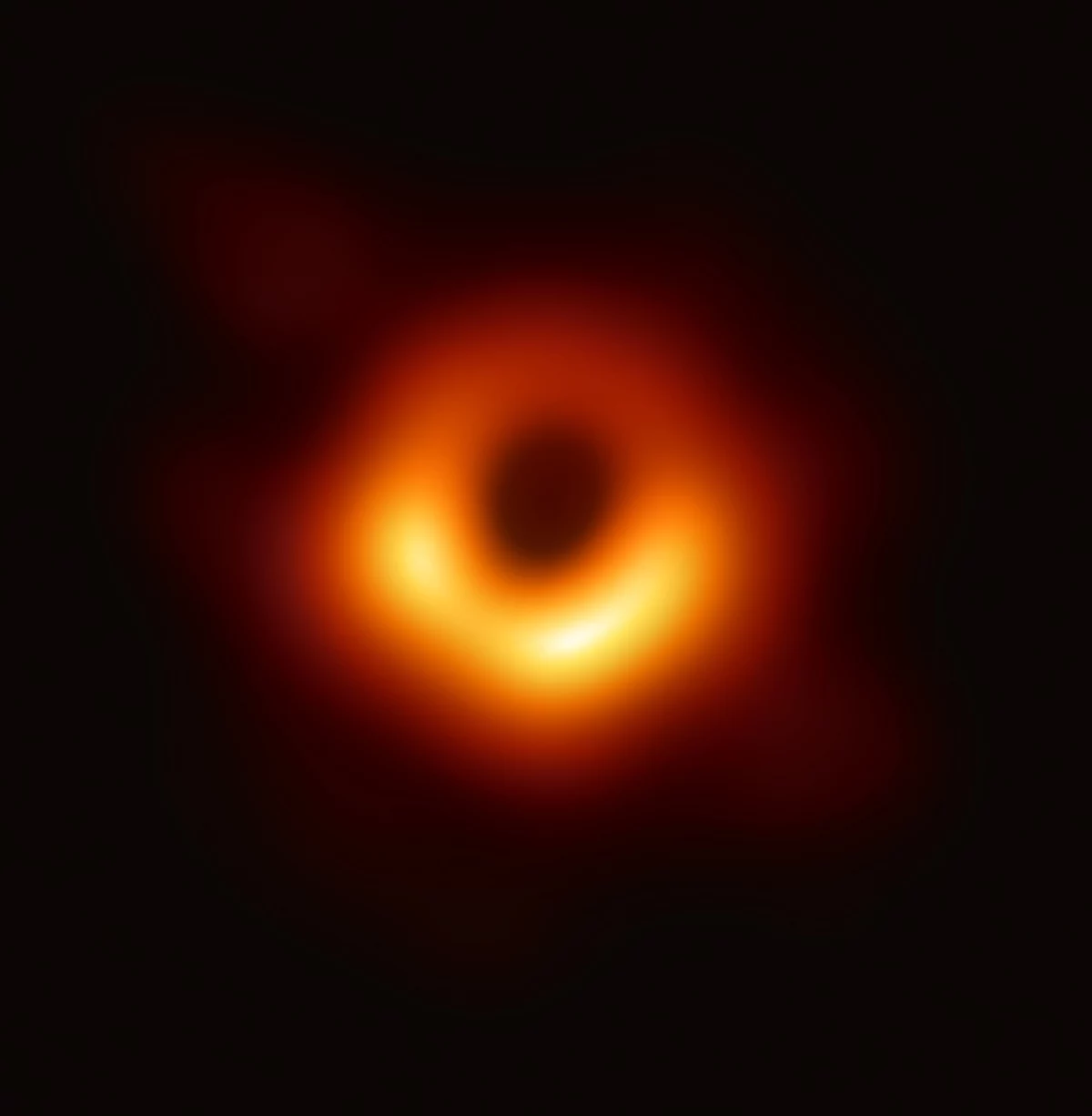
The first ever image of a black hole was released very recently on the 10th of April. The black hole shown on this image is a supermassive black 38 billion times the mass of our Sun at the centre of the M87 galaxy. The sheer impact of this image on the world has to be something everyone alive today knows.
The reason that being near a black hole is so difficult is due to its massive gravity. Black holes are black because of the fact that their gravity exceeds the speed of light This means that not even light can escape from a black hole’s event horizon, i.e, the point after which nothing can escape the black hole, a point of no return. Due to this stupendous force of gravity, space-time itself is warped around a black hole. As we know, gravity is the bending of space around a massive body. To interpret this in easier methods, if space is a soft comforter, then Earth would be a small, lightweight ball creating a slight depression in the comforter; the Sun would be a heavier ball with a deeper depression and a black hole would be the equivalent of a small, highly dense metal ball which creates a depression exponentially larger than the one created by our ‘Sun’. This bending of space-time becomes even more ludicrous when you realise the fact that if you were to fall towards a black hole, time would slow down for you and for anyone watching you from outside, you would speed up.
Now, this image may not mean anything to a lot of people, so I’ll do my best to explain it. The black part at the centre of this image is the event horizon of a black hole. The part coloured a red-orange around the black hole is the accretion disc. The accretion disk is a disk of matter which revolves around the black hole at near light-speed. The minimum distance from the singularity at which is 3 Schwarzschild radii, i.e, 3 times the radius of the event horizon. However, you may also notice an evidently brighter section closer to the event horizon. This region is called the proton sphere, and, well, it is what it sounds like- a sphere of protons orbiting the black hole. Light, unlike matter, has no mass. So, it it possible for light to orbit the black hole much closer, at 1.5 Schwarzschild radii, to b exact. Now, I’m no astrophysicist, but I did my best to explain the image of the first black hole to you.
Thank you for reading!
Follow the blog for more science content.
Here’s a video that explains this concept a little more in depth:

 The Science Hub